
The high-voltage battery of a hybrid car does not fail all at once. Before investing several thousand euros in a complete replacement, a cell-by-cell diagnosis radically changes the financial equation. Here, we detail the technical and economic considerations to know when intervening on a hybrid battery pack.
Cell-by-cell diagnosis: the key before any hybrid battery replacement
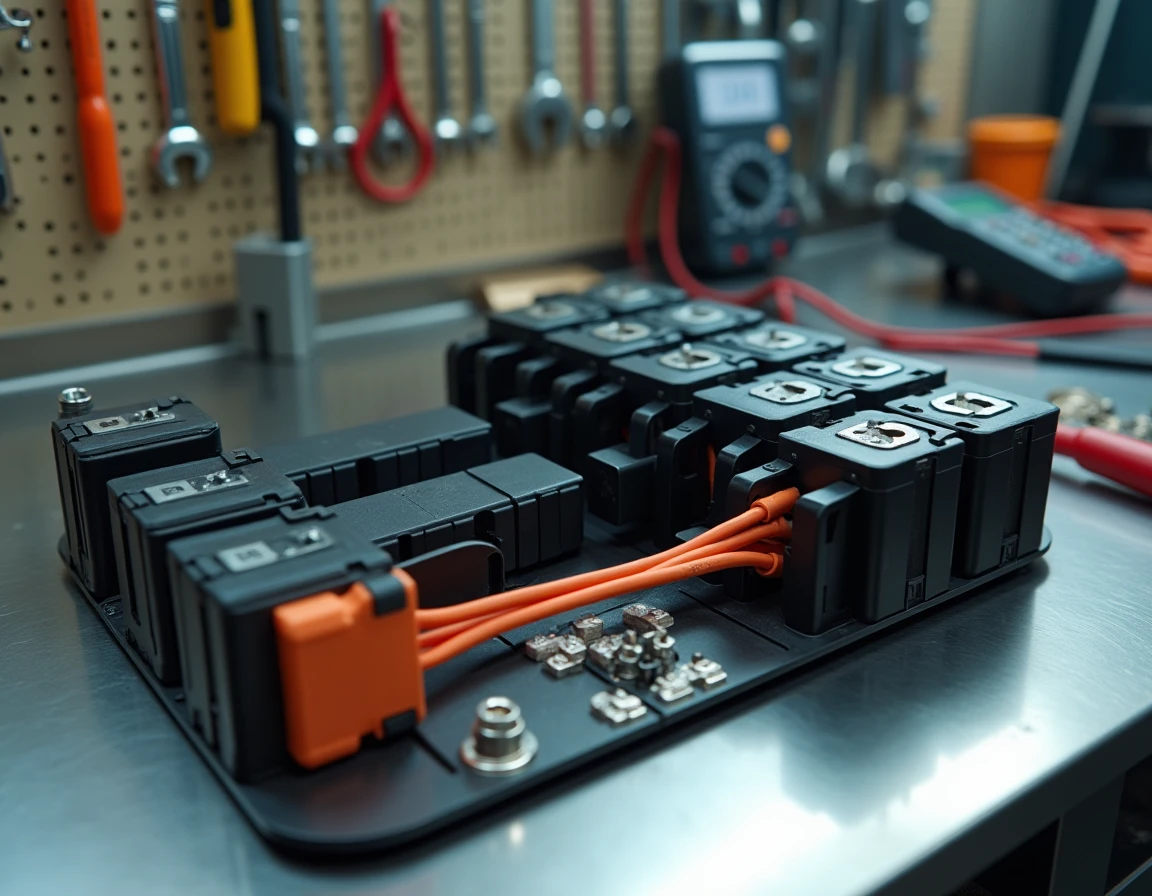
A NiMH or lithium-ion hybrid battery pack consists of several modules, each made up of individual cells. When a fault indicator lights up, the failure rarely comes from the entire pack. In most cases, one or two modules show abnormal voltage or internal resistance, while the rest of the pack remains functional.
We systematically recommend a module-by-module internal resistance test before making any decisions. This diagnosis, which can be performed with a Vencon-type tool or equivalent, precisely identifies the failing cells. A study reported by Les Numériques, covering over 8,000 checks, shows that used plug-in hybrids can mask battery health discrepancies despite an appearance of good overall condition.
Targeted replacement of only the failing modules costs a fraction of the price of a new pack. For some models, the bill goes from several thousand euros to a few hundred, including labor. The condition: the remaining modules must show a homogeneous state of health; otherwise, the new module will degrade prematurely due to charge imbalance.
Before replacing the battery of a hybrid car, this diagnostic step makes the difference between a controlled expense and an avoidable overinvestment.
Complete replacement or refurbishment of the battery pack: criteria for choice
Module-by-module refurbishment is not always relevant. Two situations necessitate the complete replacement of the pack: when more than half of the modules are degraded, or when the overall residual capacity drops below a critical threshold (often visible through the gap between the displayed battery health and the actual observed range).
When to favor refurbishment
- One or two modules show a significantly lower voltage than the others, while the rest of the pack maintains a homogeneous internal resistance.
- The vehicle has moderate mileage and the battery has never experienced prolonged overheating (repeated parking in full sun, systematic charges to 100%).
- Compatible replacement modules are available, either new or refurbished, for the model in question.
When to opt for a new or complete refurbished pack
If the diagnosis reveals a significant dispersion of internal resistance between the modules, injecting a new module into a tired pack creates an electrochemical imbalance. The new module is systematically prioritized, which accelerates its degradation. In this case, a complete refurbished pack offers a better durability/price ratio than a partial replacement repeated every two years.
Complete refurbishment involves replacing all modules while retaining the original casing, BMS (Battery Management System), and wiring. The cost remains lower than that of a new manufacturer pack, sometimes by half depending on the model.
Cost of replacing a hybrid battery: the variables that affect the bill
The price depends on three main parameters: the battery chemistry, the vehicle model, and the choice between manufacturer parts and independent suppliers.
NiMH (nickel-metal hydride) batteries, still present on many non-rechargeable hybrid models, generally cost less than lithium-ion packs. The reason lies in the lesser complexity of the BMS and the availability of refurbished modules on the secondary market.
For plug-in hybrids equipped with higher-capacity lithium-ion batteries, the bill increases proportionally to the size of the pack. Labor also represents a significant portion: disassembling a pack located under the floor requires more hours than one housed under the rear seat.

A often overlooked point: the manufacturer’s warranty generally covers the high-voltage battery for a duration or mileage greater than that of the thermal powertrain. Checking the status of this warranty before incurring expenses avoids unnecessary costs.
Preserving the hybrid battery: the practices that really matter
The optimal charging window for plug-in hybrids is between 20 and 80% capacity. Systematic charges to 100% accelerate the calendar aging of lithium-ion cells, regardless of mileage. This recommendation, widely documented for electric vehicles, applies with the same rigor to plug-in hybrids.
The battery health of used plug-in hybrids emerges, in the aforementioned study, as very close to that of pure electric vehicles, with an average gap of only 0.67 points on the health index. This figure nuances the idea that a plug-in hybrid would be more fragile than an electric vehicle in this regard.
- Avoid prolonged parking in full sun, as heat is the primary factor in the chemical degradation of cells.
- Prefer slow charging (home station or reinforced socket) over repeated fast charging, which generates more internal heat.
- Regularly monitor the state of health via the onboard diagnostic tool or a compatible OBD reader to detect any emerging imbalance between modules.
A hybrid battery pack maintained according to these principles regularly exceeds 200,000 kilometers without replacement. Regenerative braking, inherently present in hybrids, also helps limit deep discharge cycles that wear out the cells.
The choice between complete replacement and targeted intervention entirely depends on the quality of the initial diagnosis. A workshop equipped to test each module individually remains the best investment before making any decisions about the battery.